

IT Hiring Lost the Trust of Its Best Candidates. Here’s How to Get It Back.
If you’re a technology leader hiring in 2026, here’s what your week probably looks like. Your inbox has hundreds of applications for a senior DevOps role you’ve had open for four months. Half of them don’t come close to the stated requirements. Your recruiters are spending more time filtering noise than talking to real candidates. And when you do find someone worth pursuing, they’re already in three other processes.
That’s not a technology problem. That’s a trust problem. And the AI tools most companies are reaching for right now are making it worse, not better.
We at Teak Talent see both sides of this market every day, and there’s a pattern that’s hard to miss once you know what to look for.
The hiring conversation right now is fixated on AI as either the villain or the hero (depending on who you talk to). I think that’s the wrong diagnosis. The problem isn’t the tools. It’s that we’re applying mass-market automation to a precision problem, and the IT talent market is paying the price.
The IT Hiring Market in 2026 Is Not Like Everyone Else’s
Before we talk about what’s broken, it’s worth being clear about the environment we’re actually operating in, because IT hiring does not work like general corporate recruiting.
According to Robert Half’s 2026 Technology Hiring Trends report, 65% of technology hiring managers say it’s more challenging to find skilled professionals than it was a year ago, even as 61% plan to increase permanent headcount in the first half of the year. Only 7% of technology leaders say they have the skills required to complete their top priority projects.
So you’ve got a genuine talent shortage at the skilled end of the market, and a flood of unqualified volume at the application end. Both things are true at the same time. That’s the actual environment. Any solution that only addresses one half of that problem is going to create a new version of the same mess.
There’s one more number worth sitting with: 70% of technology leaders say the AI factor alone has made them more likely to turn to a staffing or consulting firm, specifically to help find candidates with specialized AI and technical skills. The market is already telling you what it needs. It needs human judgment applied at the right moments in the process.
| 65% of tech hiring managers say it’s harder to find qualified candidates than a year ago.70% say AI has made them more likely to turn to a specialized staffing firm.Only 7% have the skills on their team to complete their top priority projects.Source: Robert Half 2026 Technology Hiring Trends |
The Problem With Applying Mass-Market Tools to a Precision Search
Here’s where it starts to go sideways. Companies facing high application volume reach for automation, which is a rational response. The issue is which automation, applied where, for what purpose.
Take AI video screening as one example. Routing every single applicant through an automated video interview, before any human has looked at the resume, before any qualification has happened, communicates something specific to every experienced IT professional who sits down to record themselves: your time doesn’t matter to us.
For a DevOps engineer with two competing offers already on the table, that signal is often enough to quietly disengage. They don’t tell you. They just stop responding. You never find out your process cost you the candidate.
And this is just one version of a much broader pattern. In 2026, agentic AI systems that source, screen, schedule, and reject candidates without any human touchpoint are moving from early adoption into mainstream deployment. Over half of talent acquisition leaders plan to deploy them this year. The efficiency gains are real. But in a specialized talent market where experienced professionals have options and know it, efficiency optimized entirely at the employer’s convenience is a different kind of problem.
The most qualified IT candidates, the ones you actually want, are not desperate. They’re evaluating you as much as you’re evaluating them. A process that treats them like one of ten thousand applications is going to tell them something about your culture before they ever meet your team.
How the System Broke Itself
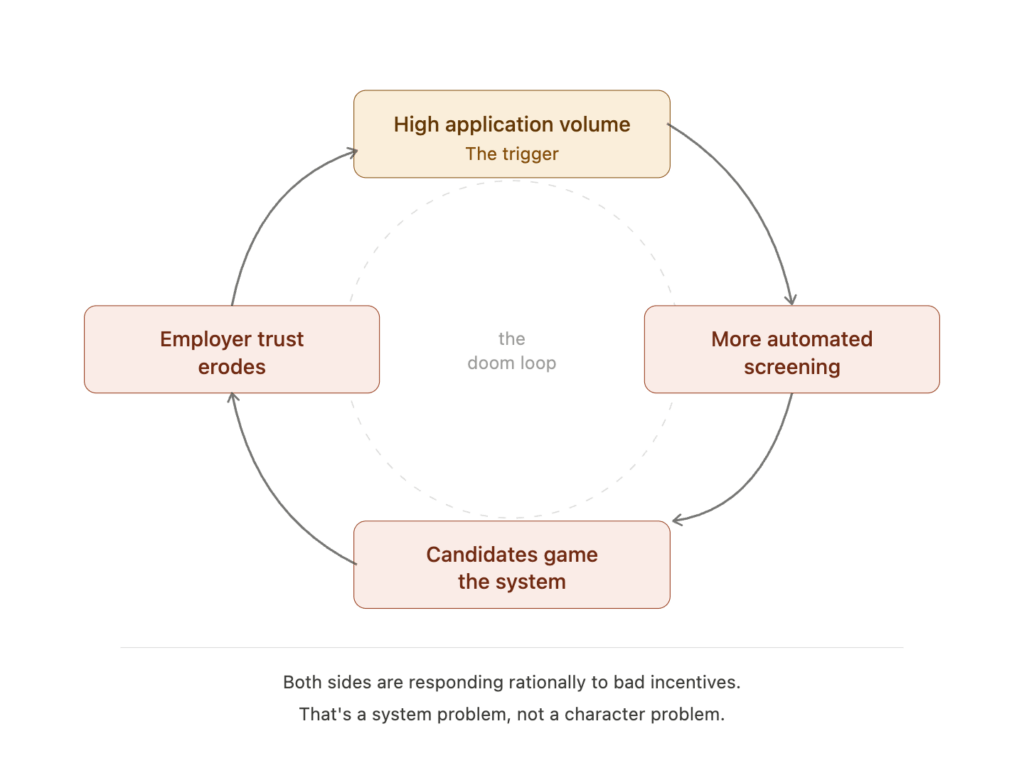
The behavior on both sides of this market makes sense given the incentives. Neither side set out to create a broken system. Both sides are responding rationally to a process that keeps rewarding the wrong things.
On the employer side: application volume exploded. LinkedIn data shows AI-generated applications drove a 45% increase in volume, running at roughly 11,000 submissions per minute. Companies responded by adding more automated screening layers. More filters. More steps. The goal was efficiency. The effect, in specialized IT hiring, was often to create a gauntlet that filtered out good candidates along with unqualified ones.
On the candidate side: when a process feels like a black box, people adapt to the black box. An estimated 40 to 80% of job applicants now use AI to write resumes and cover letters. Mass applying became normalized. Some candidates began overstating qualifications to get past automated screens they knew were looking for keyword matches, not nuance.
Neither of those things is hard to understand. Both of them make the overall market worse. And the response on each side keeps feeding the other: more candidate gaming drives more employer automation, which drives more candidate gaming. The Greenhouse CEO described it as hiring being stuck in an AI doom loop. That description is accurate.
The exit from that loop is not a better algorithm. It’s human judgment, applied at the right moments, by someone who understands both sides of the market.
Why This Hurts More in IT Than Anywhere Else
In high-volume front-line hiring, speed and automation make real sense. Candidates for those roles often want to know quickly whether they’re in or out. Moving fast is a feature, not a flaw.
IT hiring, especially for specialized roles in AI/ML, cybersecurity, DevOps, or cloud architecture, does not work this way. The talent pool is narrow. Unemployment rates for experienced technology professionals sit well below the national average. These candidates are not sitting at home refreshing their email. They’re fielding multiple conversations at once, and they have the leverage to be selective about who they engage with seriously.
A process that disrespects their time doesn’t just lose one candidate. IT professionals talk to each other. Your employer brand in the engineering and technology community is shaped heavily by how candidates experience your hiring process. One poor experience, shared in a Slack community or at a meetup, reaches more qualified candidates than your job posting ever will.
There’s also the skills verification problem. In IT hiring right now, you genuinely can’t always trust what a resume says at face value. AI-assisted applications have made keyword matching unreliable as a signal of real capability. That’s not a reason to automate more aggressively. It’s a reason to have someone with deep technical context doing the vetting, so that when you get to the interview stage, you’re not wasting your engineering team’s time on candidates who can’t do the work.
What a Precision Hiring Process Actually Looks Like
This isn’t complicated in principle, though it takes real discipline to execute. The core idea is simple: use automation where it genuinely helps, and protect the moments where human judgment matters.
Use AI for administration, not evaluation.
AI is excellent at scheduling, initial communication, parsing job requirements, and surfacing candidates whose documented experience matches stated criteria. It is not well suited to evaluating nuance, assessing cultural fit, or detecting the difference between a candidate who genuinely has a skill and one who has learned to describe it convincingly. Keep AI in the first category.
Qualify before you ask for time.
Before any candidate invests 20 or 30 minutes in a video interview or skills assessment, a human should have verified that they meet the basic threshold for the role. That can be a five-minute resume review. It can be a two-question qualification screen in your ATS. What it cannot be is nothing, followed by an automated video interview that a third of your applicants had no business being sent to.
Be transparent about your process.
Research consistently shows that candidates aren’t unreasonable about AI. They object to not knowing. When you’re clear about where automation is used and where human review happens, most candidates will engage with the process in good faith. When the process feels opaque, good-faith engagement drops.
Measure the right things.
Time-to-fill is a useful metric. It is not the most important one. If you’re filling roles in 30 days and losing those hires within 18 months, you have not solved the problem. Retention and quality-of-hire metrics are the ones that tell you whether your process is actually working.
The Hire Is Just the Beginning
There’s a business case here that gets overlooked because it shows up months after the hire, not at the close of the search.
The hiring experience is the first chapter of the employee experience. It sets an expectation. A candidate who made it through a thoughtful, respectful process, one where their time was valued and their qualifications were evaluated by people who understood them, walks into day one with a fundamentally different disposition than someone who ground through a six-stage automated gauntlet just to get a conversation.
Satisfied employees do better work. That’s not a soft statement, it’s what the organizational research consistently shows. And in IT, the cost of a placement that doesn’t hold is significant, not just in direct replacement costs but in project continuity, team morale, and the time your engineering leadership spends re-interviewing when they should be building.
The firms winning the talent war in 2026 are not the ones with the most sophisticated AI stack. They’re the ones using AI intelligently, keeping humans in the loop at the moments that matter, and treating the hiring process as the foundation of a relationship rather than a transaction to close as fast as possible.
How Teak Talent Approaches This
At Teak Talent, we’re a precision IT recruiting firm. The word precision matters to us. We don’t optimize for speed, most IT staffing firms do, because faster placements mean faster revenue. We optimize for fit, because a placement that doesn’t hold costs our clients far more than the extra time it took to get it right.
In practice that means we put human judgment at every step of the process that matters. We qualify candidates rigorously and honestly. We understand the technical requirements of the roles we’re filling, not just the job description. We represent candidates accurately to our clients and we push back when a role isn’t right for someone, even when that’s a harder conversation.
We use AI where it genuinely helps: administrative work, scheduling, market research, staying current on compensation benchmarks. We do not use it to replace the relationship-based work that makes a placement actually stick.
If your current process is generating volume but not quality, if you’re filling roles that aren’t holding, or if you’ve spent months searching for a specific technical skill set and keep striking out, the problem probably isn’t that you need more automation. It’s that you need more precision.
Tired of hires that don’t hold?
If IT hiring feels broken right now, let’s talk.